Developer: TamTam Publisher: Banpresto Release: 10/13/95 Genre: Action
The anime adaptation market in Japan is a treasure trove of hidden gems, lost classics, and sadly a mountain of crap. While there are more Gundam games than you can shake a stick at on almost every platform (seriously, look at this) lesser known series also got their day in the spotlight. Iria: Zeriam the Animation was a Sci-Fi Channel staple in the late 90s. The series was incredibly cool and prime fodder for a video game. Apparently Banpresto thought so too as they would release Hyper Iria for the Super Famicom near the end of its life cycle in Japan. There are many good points with this one. But there are just as many flaws that prevent it from reaching its full potential.
Hyper Iria is a side-scrolling action game based on the mid-90s anime Iria: Zeiram the Animation. The OVA itself is a prequel to the live action movie Zeiram. The OVA and this game and their events both contradict the movie but that is not important. Hyper Iria is only a loose retelling of the animated series with detours and story related events added for the sake of gameplay. There was no way in hell this was releasing in the US as it was an October 1995 release in Japan and the 16-bit platforms were already rapidly declining. Luckily there is a fan translation which makes the game accessible as you need to understand mission objectives. The question is the game worth your time?
In the show Iria has access to a vast arsenal of weapons and equipment as a bounty hunter. That remains true of the game. Before each mission there is a pre-planning phase where you buy weapons and items from the shop and create a load out. There are a number of guns, an assortment of grenades plus a plethora of secondary items like glider wings and extra jump height. You earn credits to buy these based on performance at the end of levels where you are graded. You can also find some of this equipment or earn them as drops. It sounds in depth however the majority of it is fluff you do not need due to the structure and pacing.
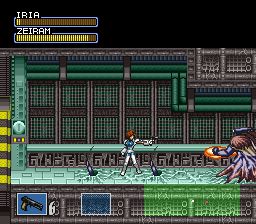
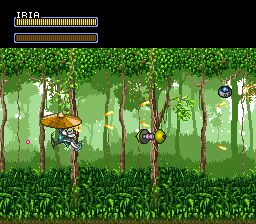
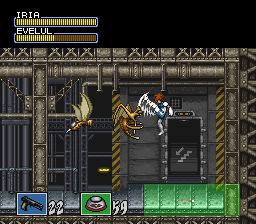
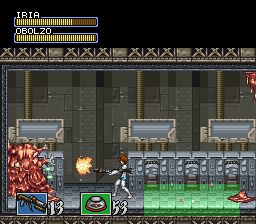
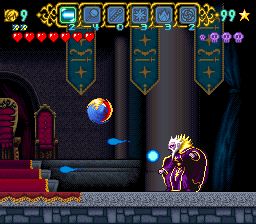
Hyper Iria presents itself as a run and gun action game. However it has more in common with Metroid than Contra. Each level is a sprawling maze with a specific task. The action is there but it feels secondary to exploring each labyrinth. Your AI computer Bob offers guidance toward your goal as the map if you can call it that is useless. These instructions are necessary as levels recycle assets heavily with few if any landmarks, making it hard to memorize them. You can wander off the suggested path to explore and find items if you choose. But this often leads to getting lost and generally speaking the game’s arsenal of equipment is not worth it.
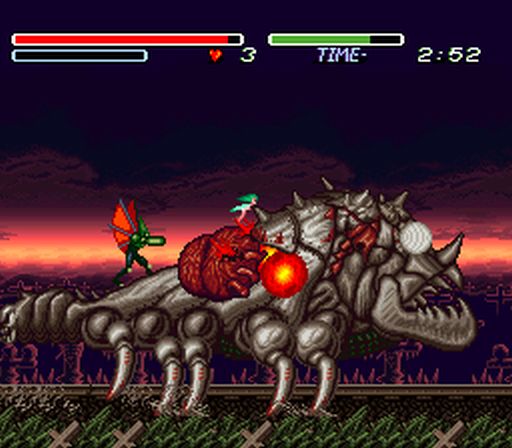
Perhaps Hyper Iria’s greatest failing is that it gives you so many cool tools but does not design itself around them. Take the various weapons for example. Each gun has limited ammo and is slow. Ammo drops are rare which should make weapon use strategic. However they are so weak it is usually not worth bothering. Melee attacks, especially kicks are the most powerful as they hit multiple times and worth the risk. There are way too many different grenades considering they are situational at best. And the tools see limited use. The glider wings were maybe helpful in one specific level if that. And I cannot say there was any situation where I needed the extra jump height from the boots. Iria is so versatile from the start you can ignore the shop and barely notice. I respect the faithfulness to the anime but they could have done more.
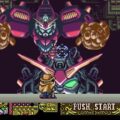
Hyper Iria is a game that is on the cusp of greatness but is lacking polish. The art, animation, and even between level cutscenes are stylish and high quality. But the game suffers from crippling slowdown for no reason. Navigating the environments from a movement perspective kind of feels good at times. But the controls are sluggish and along with the performance issues will lead to missed jumps and such. It also affects the action as there are hit detection issues meaning you will take damage regularly in most exchanges. This is not a particularly difficult game as the enemies are sparse and their AI is dumb. I wish the developers ironed out some of these flaws and better balanced action with exploration. The pieces are there, they simply need to be assembled better.
In Closing
Hyper Iria is a competent, occasionally stylish anime tie-in. Compared to how these go the game is slightly above average and just shy of being a solid endeavor. It never rises to greatness, but fans of Iria: Zeiram the Animation or obscure 16-bit action games may find it worth a look. For most, though, it pales in comparison to heavy hitters of the genre on the same platform. Maybe if this were an earlier release I would look on it more favorably. But as a late 1995 release, against the many classics hitting at the end of the generation it does not stack up.