
Developer: Nihon Bussan Publisher: Vik Tokai Release: 03/90 Genre: Shooter
There’s something to be said about a timely release. Video game design is always moving forward. A game that was groundbreaking one year is eclipsed the next. Vic Tokai’s Terra Cresta was a Famicom release in Japan in 1986, a year after its arcade debut. However it would not come to the states until 1990. Whatever charm and innovation the game possessed had long been surpassed by superior titles leaving me to question why they even bothered.
At first glance Terra Cresta looks eerily similar to Xevious with a few extra shades of brown. Despite being a sequel to 1980’s Moon Cresta the two share very little in common. Aside from the combining ship function this skews very close to Namco’s classic. The key difference is there are no distinctions between ground and aerial targets and the game has extremely strong power-ups. Some might say they are a bit too much for this modest game.
Terra Cresta’s defining feature is its combining ships. Where Moon Cresta has two ships to dock with that number has doubles to four here. Each of the four additional ships are numbered and has a specific weapon that adds to your arsenal. These are pretty standard stuff such as double the firepower, rear guns, and a force field. What is cool is that they all stack. They also increase the size of your ship making you a larger target but the tradeoff is worth it. The ships take a bullet in your stead and if you collect all four you become an invincible phoenix briefly.
You can separate your parts into preset formations for a few seconds which produce even more powerful effects. You can only do this a few times but it replenishes whenever you acquire a new ship. One feature unique to this version is a design mode. This lets you edit the placement of your ships when once assembled including their firing direction. It is a decent extra but a waste since you cannot even use the formations that often.
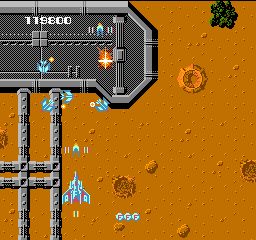
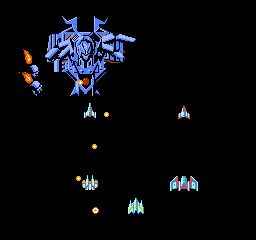
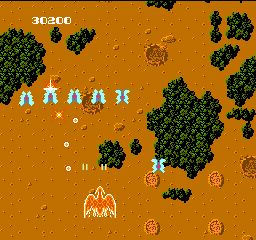
Terra Cresta does not have traditional levels as they lack the typical end level fanfare or break points. However there are boss battles which somewhat signify the end of the current section. Going by this the game has four “stages” total which is meager by shooter standards. Similar titles around its release such as Zanac had 12 which give you your money’s worth. It also does not help that there is not a whole lot of variety in the game. There are only a few enemy types that recycle for the brief period the game lasts.
Death in most shooters is a pretty damning experience since you lose all of your hard earned weapons. Terra Cresta is especially cruel in this regard. The default ship is extremely weak and can barely survive until you can find your first upgrade. Later levels pepper the screen with bullets or enemies that come from all sides and chances are you if you die it will simply start a domino effect where you lose all of your lives in rapid succession. It doesn’t help that power-ups aren’t very common either.
With that in mind it is not as though the game is difficult. Even with a large fully upgraded ship you will destroy most waves before they let off a single shot. Usually shooters that allow you to sustain a few hits feature more frantic action to justify it. Here however the game moves at a snail’s pace which makes your makeshift shield seem a bit game breaking. You won’t get to use it often but the phoenix is similarly too powerful even though it lasts about 10 seconds. If you bother to continue playing after it loops the game does become more difficult with faster bullets and enemies. But there is no reason to bother going that far.
Possibly the most damning aspect of Terra Cresta is that it has no conclusion. Once you complete all four of its “levels” and defeated what is clearly the final boss the game loops infinitely. In the arcade where it was common to compete for high scores it is great. But for a home port it does feel unsatisfying. The NES release came years after Japan at which point more advanced and better shooters such as Life Force, 1943, and Zanac were on the market, making it look weak in comparison. Maybe reception would be more favorable if the release were punctual but by 1990 it shows its age.
In Closing
There are a few cool ideas present in Terra Cresta however the game surrounding them simply does not hold up. You are better off checking out Over Horizon, a game with a similar formation editor that is among the best for the system.