
Developer: Nihon Bussan Publisher: FCI Release: 10/88 Genre: Action
I remember desperately wanting to play Magmax growing up. From the cover art it looked like an epic adventure of giant robots fighting three-headed metal dragons and shit and I wanted all parts of it. That is the power of good box art. Anyone who owned an Atari 2600 knows that feeling; they hired professionals to draw fantastic scenarios depicting the gameplay but the reality was….less than stellar. But I never got around to it, not when I started renting games or buying them myself. In hindsight that was a good choice as Magmax is not a particularly good game. As a port it is decent but as a game it is lacking.
Magmax hit the arcades in 1985. The following year it would release on the Famicom but it would not hit North America until 1988. I realize that this is an old arcade game but that late release did it no favors. By ’88 games like 1943, Life Force, and Zanac were advancing the genre. In comparison Magmax offers little to hold players attention, even those that like to play for high scores.
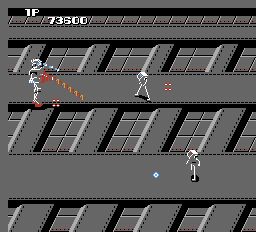
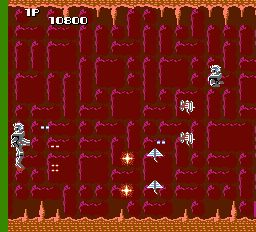
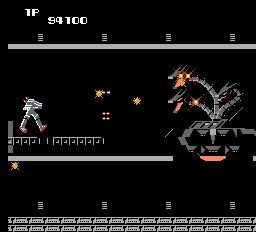
Magmax is a side-scrolling shooter that takes place on two planes. Above ground the level is slightly tilted in an almost 2.5D format. The playing field is elevated and scrolls vertically as you scout for power-ups and defeat enemies. It is a little confusing at first but is intuitive in short order. By dropping into random holes in the floor you can travel underground. Here the game becomes a traditional horizontal shooter both in its look and enemy waves. These two facets make the game more interesting than the typical shooters of its time. But that is not its only cool trick.
On its own your ship is not powerful. The tank like ship is small and weak. But by collecting three separate parts you can assemble them into one giant mecha that stomps through each level. Collecting each part (legs, torso, wave cannon) attaches it to your ship and alters your firepower. It is pretty goofy to see a ship attached to a pair of legs or a giant floating torso but there you go. They also allow you to take a few extra hits before death. The power comes with a cost as you become a giant moving target at full power. But it is worth it for the extra survivability. Although it may sound like a hassle to put the mech together the game is fairly generous with parts so you rarely stick with the default ship.
As cool as the game’s premise is it cannot hide the fact that as a whole Magmax is boring. There are only three environments not counting the underworld sections. Each is long and drab and rarely changes but more importantly are sparsely populated, at least above ground. The excitement of assembling the full mech wears off pretty quick once you realize you have to work twice as hard to keep it for any length of time. The underground portions of each level are more interesting but grow repetitive in short order due to a lack of enemy variety. Considering there are technically only three stages that is sad. Magmax feels like relic next to Gradius and Zanac but the reality is it was released around the same time originally.
Like many arcade games of its time Magmax has no end. Once you have cleared what is the equivalent of its third stage it loops indefinitely. For those that like to play for high scores normally I would say this is the game for you. But in this case I think the core of the gameplay is simply not interesting enough to want to go through it more than once. I may not be particularly fond of Stinger but mechanically it is far more interesting and varied in my opinion for those that are score hunters. Once the novelty of Magmax’s core gimmick wears off five minutes in to the game it is boring after.
In Closing
Magmax is not a good game and shows its age. Even if its North American release were timely it would not stand up to its competition. This is one that you had to be there to appreciate its finer points.