Developer: Vik Tokai Publisher: Vik Tokai Release: 01/90 Genre: Action
This review has been a long time coming. I have started and stopped Clash at Demonhead numerous times for one reason or another over the years. It is not that I do not like the game, I do. But every time I would sit down to play it some distraction would crop up. Now that I have had the chance to play it from beginning to end at last my feelings about this odd game have not changed. Clash at Demonhead is a strange game like many of Vik Tokai’s other titles. It reminds me of Golgo 13 in many ways. But unlike that well-meaning train wreck this is a solid adventure and an underrated gem.
Billy “Bang” Blitz, agent of S.A.R.G.E (Special Assault Brigade for Real Emergencies) is on vacation with his girlfriend when he receives orders to save Professor Plum, creator of a doomsday weapon capable of destroying the world. The villains behind this kidnapping? An organization by the name of Demonhead. Like many NES games Clash at Demonhead flew under the radar. However it did receive a boost in popularity long after the fact thanks to the Scott Pilgrim comics and movie which is pretty cool. It helps that the game is actually pretty good too.


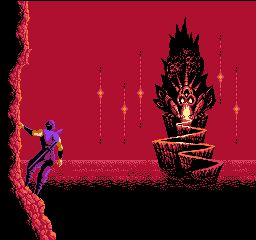
At first glance Clash at Demonhead looks daunting. The overworld map consists of 42 interconnected “routes”—individual side-scrolling stages—that you can explore at your leisure. There are various nodes that branch off in as many as four directions and the game does not give any direction at first. The end of the first route offers a vague goal, collecting seven medallions, but where they are is a mystery. The initial stage of Clash at Demonhead can be frustrating for this reason. Stumbling about on the map with no guidance is annoying. But after a few levels you do get some direction and it snowballs from there. You are often told to visit specific zones and the route you take to get there is in your hands. Although there are technically 42 individual stages they are mercifully short. Stick it out and the game’s charm will win you over.
Although Clash at Demonhead has the look and pacing of a metroidvania your progressions is not limited through upgradable abilities. In fact you have almost everything you need from the start. Bang’s weapons and tools can all be purchased from the game’s shop. At first it is only at Zone 5. But you can buy a cheap item to summon it at any time. The weapons vary in their use but suffer from limited ammo. The suits are more interesting. These include a jet pack for flight, an aqua lung to breathe underwater and the hyper suit, which boosts defense and allows you to survive in lava. All suits use fuel that generally lasts so long you can run around in them for quite a while. Although you have to purchase these temporary items the game gives so much gold it is never an issue.
The force powers are the closest to permanent upgrades. You receive five abilities during the game: micro power to shrink, levitate, teleport, energizer, and karate power which is invincibility. Technically they use force power. But you have so much I never bothered to check how much I had at any given moment. Honestly outside of energizer and teleport I did not really bother with the others. Micro power sees little use and the jet pack replaces levitate. While force powers are underutilized a bit they at least add to the game in a strange way.
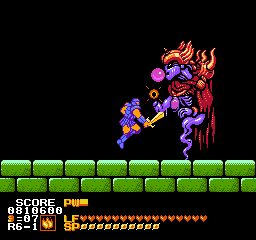
On its face Clash at Demonhead has many traits that should make it a mediocre game. Controls are responsive but slightly stiff, especially during platforming sections, which can cause frustration during jumps or boss fights. The cryptic hints and confusing navigation are also frustrating. And it has a mean difficulty curve, especially at the start. Yet the game is more than the sum of its parts. While the controls could be better they are good enough. The game rarely requires precision in its platforming and action. And while the outset gives little guidance it picks up quick enough. The charming localization glues it all together and is what kept me playing. Clash at Demonhead is like Legend of the Mystical Ninja, a game so Japanese it is both strange and endearing. They do not always turn out well, but I am glad it is not the case here.
In Closing
Clash at Demonhead is a flawed gem—an ambitious NES title that tries to do more than was common at the time. Those not afraid of a bit of trial-and-error will find a rewarding experience that still holds up today. It is funny, for such an understated release that flew under the radar its cult following now is a bit baffling. At least I can say there is a good game behind it.