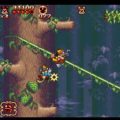
Developer: WayForward Technologies/Designer Software Publisher: Hi-Tech Expressions Release: 02/94 Genre:Puzzle
I do not envy the developers of Mickey’s Ultimate Challenge. As a 1994 release it was sitting on store shelves next to Mickey Mania. That is an unfavorable position for any game to be in considering the production values and hype surrounding that title’s release. And while Ultimate Challenge and Mickey Mania both have a different focus the comparison is inevitable. The truth is even without Sony’s game overshadowing it Micky’s Ultimate Challenge would still be a poor game.
The plot begins with Mickey (or Minnie) reading a book about a magical kingdom and daydreaming about living in a castle in a faraway land. They fall asleep and awaken to find themselves in a medieval land called Beanwick. Here the castle shake due to mysterious reasons that no one can ascertain why. Mickey volunteers to figure it out and must complete a series of puzzles and help various inhabitants of the kingdom. Curiously Mickey’s Ultimate Challenge is one of the first titles developed by WayForward Technologies. All I will say is everyone has to start somewhere.
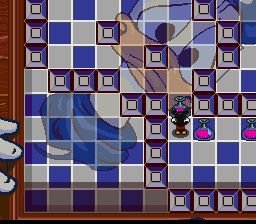
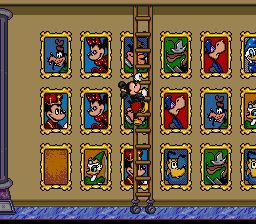
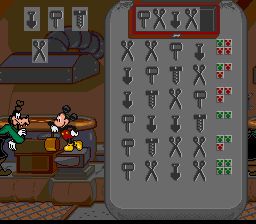
At its core Mickey’s Ultimate Challenge is a puzzle game and collection of six mini-games. The goal is to collect magic beans to create a giant beanstalk tall enough to reach the clouds to find the cause of the rumblings in the land. In the castle are various familiar denizens who need your help with simple tasks. These take the form of games that emphasize different qualities like pattern recognition, memorization, logical deduction, and basic reading. Completing these games awards an item that you can than give to someone else to receive a magic bean in return. Simple right?
The various games are simple and help build certain skills. Playing the Pipes and Picture Matching both emphasize memorization. To help Huey, Dewey, and Louie clear the blockage in the pipes you must play back the melody on the pipes as it becomes progressively more complex. Picture matching is a card matching game and self-explanatory. Moving Potions is a sokoban style block pushing on a chess board. Sorting Books helps you learn your ABC’s as you execute a little platforming to sort the books in alphabetical order. Guess the Tools is a little more difficult. Here you must guess the tools in Goofy’s bag and in the correct order. You receive a few clues but this one is the most challenging depending on the difficulty setting. While technically not a game per se you also must correctly deduce how needs each item to receive their magic bean.
I find it kind of hard to assess Mickey’s Ultimate Challenge overall. It succeeds at being an accessible and safe game for kids. It teaches valuable skills like basic problem solving and helps with memorization. But at the same time the games are dull due to their simplicity. Even on higher difficulties you play the same game longer rather than introducing new mechanics. The game is also short; there are technically only six games that are so brief you can finish the game in 15 minutes. Once it is over there is no replay value either. I can only picture extremely young children around 4-5 having any interest in this as it has limited appeal.
It is ironic the game is called Mickey’s Ultimate Challenge when the game is anything but. The game is clearly targeted at young children and as such removes barriers such as health, lives, and any such fail states. This makes it extremely forgiving and non-frustrating. Each game asks little of you as the player with one exception. Goofy’s Blacksmith Shop is a frustrating game of MasterMind that is tedious and wears out its welcome. There are three difficulty levels that affect the length of each game and suitably ups the difficulty. While I found the overall game to be easy I will say the end game sliding puzzle is a nightmare on Medium and Challenging. I imagine a lot of kids were left crying with that one.
In Closing
Mickey’s Ultimate Challenge is a simple, educational puzzle game that serves its purpose: providing a low-stress experience for young children. Its value lies in its accessibility, wholesome content, and classic Disney charm. Veteran gamers will find nothing appealing here unfortunately; even raising the difficulty only increases the tedium. Even as a kids game I would probably recommend something else like Disney Illusion Island first.