Developer: The Game Kitchen Publisher: Dotemu Release: 07/31/25 Genre: Action
Also on: PS4, PS5, Xbox One, Xbox Series, Nintendo Switch
Ninja Gaiden was long overdue for a comeback. After a spectacular revival in the early 2000s the series fell on hard times with subpar entries that never should have been released. Seriously who approved Yaiba: Ninja Gaiden Z? But 2025 has proven to be Ryu Hayabusa’s year on multiple fronts. Ninja Gaiden 2: Black reminded everyone why we love this series. Ninja Gaiden 4 is a worthy follow-up that rights the ship after the mediocre third game. Yet Ninja Gaiden: Ragebound is possibly the best of this trio of great games. Ninja Gaiden: Ragebound is a modern return to the franchise’s 2D roots, blending classic retro-style action platforming with tight modern controls, strategic combat, and is easily one of the best action games of the year.
The story of Ninja Gaiden: Ragebound runs parallel to the original NES game. Ryu receives a letter that his father has fallen and that he must visit his colleague in America to honor his will. In his absence the barrier between the human and demon worlds breaks and it is up to his apprentice Kenji, a Hayabusa ninja in training to stop the threat.


Like its Nintendo counterparts the game has many cutscenes that further the story. And just like those games the plot is interesting enough to warrant your attention. Early on Kenji works with Kumori, a ninja from the rival Black Spider Clan. Their contentious relationship drives the plot, as they go from roasting each other to eventually earning each other’s respect. I enjoyed this aspect of the story the most, both because it was unexpected but also well done. That is just one of this fantastic game’s good qualities.
After the brief tutorial it is immediately clear that Ninja Gaiden has not missed a step. At its core the Ninja Gaiden games have always been about fast, fluid 2D action. Ninja Gaiden: Ragebound delivers that in spades but refines it with modern design. Kenji can climb any surface like Ryu and deflect projectiles defensively. He can also dodge roll and lunge attack enemies. Part way through the game Kumori enters a spirit contract with Kenji, giving him access to kunai and special weapons. She is also playable, with one entire dedicated chapter and specific segments that require her unique platforming abilities. New to the series are Ragebound arts, stupidly powerful techniques like Shinobi’s ninja magic that can deal massive damage, heal or even create shields.
One of the most important combat skills is the hypercharge. Killing marked enemies or sacrificing a portion of health grants a hypercharge, a powerful instant kill move. While most enemies die in a single hit there are frequently more powerful demons and such that are more resilient. Part of the game’s design is that there is always (always!) an enemy nearby that will grant a hypercharge to kill them instantly when done correctly. Hypercharge attacks stun bosses to grant free hits too. Playing the “game” to accrue hypercharges to shorten boss battles or instakill armored foes adds a dimension to the straightforward combat I like.


Hyper charges are key to combat. For platforming almost the entire game is built around the Guillotine Boost. This critical skill serves as both an attack and a mid-air boost to assist in platforming. It sounds simple but its applications are widespread. The guillotine boost can be used on anything, from enemies to projectiles. You can chain it consecutively to cross gaps, escape danger, and even dodge attacks, especially from bosses. Some of the game’s best scenarios use it to great effect, from dodging a seemingly impossible boss move to finding secrets by guillotine boosting off multiple conveniently placed enemies. Guillotine boosting off multiple enemies and multiple projectiles to grab a secret never gets old. This is one of the smartest additions to the game and one that truly makes it feel unique.
Despite the addition of all these tools Ninja Gaiden: Ragebound feels snappy and responsive thanks to excellent controls. Movement feels slick and responsive, rewarding well-timed jumps and quick reactions. Despite the lengthy tutorial you will be slashing, dodging, and weaving through enemies with satisfying feedback, mixing offensive and defensive play. Despite your large move set the game has the same snappy pacing of its 8-bit predecessors. It can be a bit predictable; whenever you see a sturdier enemy or one with an aura you know a hypercharge is coming. But even when you see it coming it still comes down to execution to avoid wasting it. Combat is challenging but fair, emphasizing pattern recognition, spacing, and mastering risk vs. reward, especially during the generally excellent boss battles.
As much as I have gushed about combat the platforming is just as strong if not better. The level design is phenomenal and varied. Enemy placement is deliberate, both for combat reasons and for platforming. Taking advantage of your numerous skills will enable you to find the game’s many secrets like golden scarabs and crystal skulls. Guillotine boosting is frequently called on and can lead to alternate paths through levels as well. If I have one complaint it is that levels can run a bit long. I appreciate the amount of secrets and collectibles they hide but it does get a bit repetitive at times. It is not like the game needs the padding. The main campaign will take anywhere between 5-10 hours and there are numerous “secret” levels that are very hard and will add a few more hours to that total. The game is not lacking in content.
Overall Ninja Gaiden: Ragebound has its moments but strikes a balanced challenge on the medium setting. The pacing is near perfect. There are frequent checkpoints that restore a significant portion of life in every stage. Life restoring orbs are spaced out evenly as well. The platforming will challenge you to use every ounce of the movement capabilities in creative ways and always feels satisfying. The boss battles are the one point of contention. They have readily identifiable patterns and the game provides multiple tools to (hopefully) shorten each bout. However their life bars are excruciatingly long and they can feel like damage sponges. If they were a little shorter it would be perfect.
For those that were weaned on the later 3d titles the game caters to you as well. There are several equippable talismans that increase the difficulty significantly. The secret ops levels will truly test your mastery of all the game’s mechanics as well. And if you want more hard mode becomes available upon completing the game once. Personally I only played around with these options out of curiosity. The most important factor for me is the difficulty is challenging without feeling punishing, especially compared to older Ninja Gaiden games.
In Closing
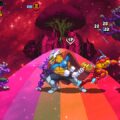
Ninja Gaiden: Ragebound is a spectacular revival of the franchise’s 2D roots. It blends fast, precise action and platforming with gorgeous pixel art, satisfying combat and boss encounters to be one of the best action games I have played in years. It is accessible for newcomers, rewarding for veterans, and full of retro flair that feels both nostalgic and fresh. This is a must-play for action platformer fans and a worthy evolution of the Ninja Gaiden legacy.