
Developer: Sega Publisher: Vik Tokai Release: 1994 Genre: Puzzle
How do you make a sequel to a puzzle game? Usually most puzzle games nail their core concept on the first try leaving little room for improvement. You can go in an almost completely different direction a la Tetris 2. Or you can simply change the focus like Sega did with Columns III. Competitive play is one of the key ways to give any game infinite replay value when executed well. Columns III only kind of succeeds at that. When playing against a friend it is great. But as a solo experience it is lacking. That right there is pretty damning but their change in focus damages the game overall.
The core conceit of Columns remains the same. This is a match three puzzle game where colored jewels fall in stacks of three and you match the colors to clear them from the board. Matches can be horizontal, vertical, or diagonal with multiple occurring simultaneously. While not as satisfying as clearing entire lines as in Tetris seeing unexpected combos and chains produces a similar rush. There are a few new mechanics however. The crush bar, which raises the floor on the opposing field while lowering yours one level in addition to destroying their current column returns from Columns II. This time you can initiate a crush attack manually with enough points. This is the main mechanic the game leans on as the focus shifts to competitive play.
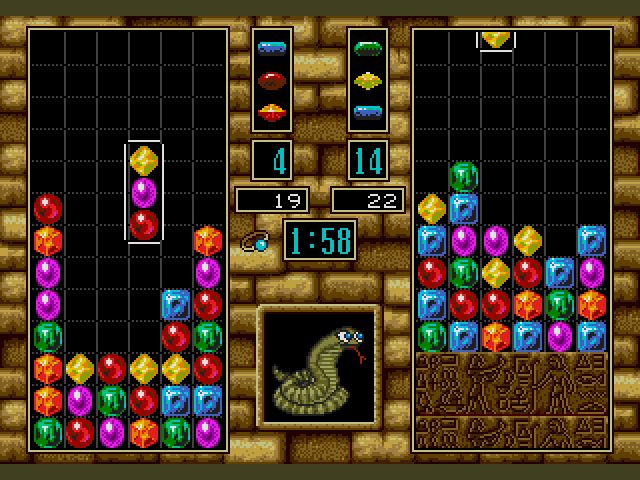
Columns III is all about the one-on-one competitive format. In all of the game’s various modes you face another opponent even in the game’s single player arcade mode. The arcade mode is structured like Puyo Puyo as you face an ever increasingly difficult array of opponents in three round matches on the way to its conclusion. Technically there is a story or some such about searching for a treasure in a pyramid. But it is not important. The game ramps up the competition as you send “garbage” or obstacles to your opponent’s screen by clearing gems to gradually overwhelm them. You can also collect special power-ups that shift the balance — like reducing your opponent’s screen space, inverting their playing field or clearing rows of gems from your own.
From a competitive standpoint all of these additions make matches exciting. Now it is not simply a matter of clearing your playing field to rack up points. You must also keep an eye on the opposite field lest you are caught unaware. There is an interesting flow as attacks launch left and right and victory or defeat comes in a flash. The problem is the game can be too complex at times. In addition to the mechanics I outlined above there are magic stones that drop after every twenty lines. These can remove your crush bar, crush your opponent, or remove all jewels of a certain color depending on placement. Flashing stones produce a number of random effects on top of this too. Trying to manage all this while working on your field is chaotic and ruins the simplicity of the formula.
There is a sharp difficulty curve as a result of all these compiling mechanics. By your third opponent they become ruthless and will not hesitate to use all of the tools available to win. I was not joking when I said defeat can come suddenly as the AI reacts with uncanny precision. I appreciate the challenge but as this is the only single player mode it gets old fast. Multiplayer is where Columns III shines as it supports up to five players via a multi-tap peripheral. It becomes a frenetic party game as attacks are going off left and right and you can better appreciate the game’s depth. I am glad that there are a range of multiplayer options. But I wish it were not at the expense of the solo experience.
This is the elephant in the room. What ultimately kills the appeal of Columns III is the lack of a traditional single player mode. Sure dunking on your friends and the computer can be entertaining. But sometimes you just want to see how high a score you can achieve, time permitting. Why they removed the endless arcade mode I will never know. That is the most basic mode every puzzle game should have! The arcade mode is fun the first time but not interesting after that. And time trial is a poor substitute and does not make up for its absence.
In Closing
Columns III: Revenge of Columns has its good and bad points. As a competitive title it excels with excellent support for up to five players. The multiplayer mode also ignores the crazy items for a pure experience that is sorely missing against the computer. But if you do not have friends the game is lacking and is merely a mild diversion rather than a timeless classic you can pull out every now and then for a brief bit of fun.