Developer: MileStone Publisher: O~3 Entertainment Release: 12/05 Genre: Shooter
I will always lament the death of the shooter during the sixth generation in the US. Some of the most brilliant arcade games received home ports on the PS2 that released in Europe and Japan but America was left out. If there was a drought on the PS2 then it was non-existent on the GameCube and Xbox. Surprisingly toward the end of its life a few did release on Nintendo’s purple box and they were interesting to say the least. Chaos Field is a Treasure style shooter that is nothing but boss battles. But while it is similar it lacks the flair that Treasure imbues in their titles and is a hollow experience.
Chaos Field has a bit of a pedigree behind it. As the creation of developers from the dearly departed Compile the creators know their stuff. But it went through development hell before eventually releasing in the arcade first. Ports to the Dreamcast, PS2, and GameCube would soon follow but only the Nintendo version would see an international release. As one of only two shooters for the system in the US (the other being Ikaruga) it is decent. But if you really want a shooter fix you are better off going with the other game.
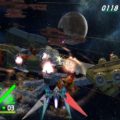
Chaos Field is both a bullet hell shooter and a boss rush. There are five phases with three bosses each with no fodder enemies in between. Each fight has an almost fighting game style presentation as the bosses have a life bar, a timer, and even a combo counter. The bosses all have multiple parts and turrets although you do not have to destroy every part to defeat them. However if you want a higher score doing so within the time limit is key. There is a trick to this which leads in to the game’s elaborate scoring system.
Like many shooters of the time Chaos Field has multiple characters. Each character has their own ship with a unique set of weapons as well as strengths and weaknesses. Hal is the most balanced between speed and power. His ships twin shots are as basic as they get and the closest to a spread shot in the game. Ifumi is the fastest but lacks power. However her ship’s six lasers lock on to the nearest target and follow them until death. Jinn is the slowest but has the most powerful weapon in its lightning blast. Sadly it has short range meaning you must place yourself in immediate danger to reap its benefit.
The game is mechanically dense beyond the choice of ships. Aside from their primary weapon each ship has a sword that can cancel out every non-purple bullet which is crucial to dealing with the game’s madness. You can perform a sword combo however this incurs a cool down that varies between characters. The Wing layer is a deployable shield that also cancels bullets and is unique to each character. It does not grant invincibility despite technically being a shield and is more of a last ditch save as it uses charges from the meta gauge. The meta gauge is used more for the lock-on laser, the best way to dismantle bosses quickly.
The most critical aspect of the game and where it gets its namesake is field switching. At the press of a button you can switch between the chaos and order field. There are stark differences between each field: the order field is more tame as bosses are less aggressive, have fewer moving parts, and spawn a lot of meta stock to replenish the meta gauge faster. Your weapons are also weaker here to match the lighter pace. The chaos field is where the game gets nuts. The game truly evolves in to a full on bullet hell as the bosses transform with more turrets and cores. To match the frenetic pace your weapons change and become stronger too. Your lock-on lasers shine here but meta stock drops slowly limiting your ability to keep long combos going.


There is a lot to remember in the middle of the game’s chaos. But with practice it becomes second nature and you will appreciate the strategic depth the game’s systems provide. Sure you can stay in the order field and slowly whittle a boss down but it is boring. The mechanics are there to exploit. You can take advantage of the seconds of invincibility when field switching to avoid damage. Building up resources in the order field to unload in chaos mode and then changing back before it gets too manic is awesome. The field switching and lock-on laser are key to the combo system. Every bullet absorbed and locked on adds to the multiplier and to maximize it you must field switch. The bullet hell is not just an impediment; it is there to rack up high scores. This nuance adds an additional layer aside from strictly boss battling.
I like the tight marriage between the boss design and the mechanics and find it enjoyable. Yet I still found myself wanting more from Chaos Field. The lack of lesser enemies leading up to each boss leaves each level feeling a bit hollow. Sure they were cannon fodder but it was something. Original mode adds this but it feels half-hearted. As the bosses are the entire game each encounter feels dragged out. In addition while some of the boss designs are cool they start to feel repetitive. This is where Treasure’s creative design shines and where Chaos Field falls short. Each encounter starts to look and feel the same after a while. In a game where the bosses are the draw fumbling this aspect hurts the game’s appeal a lot.
In Closing
It is hard to put a score on Chaos Field. What is here is good and I like it. As a bullet hell it is accessible and even though the challenge is high it always feels manageable. But I will admit that I wish there were more to the experience. Even though I enjoyed the time I spent with it I still find it hard to outright recommend it unless you are looking for something this specific.